Download the free sample
What’s in the free sample?
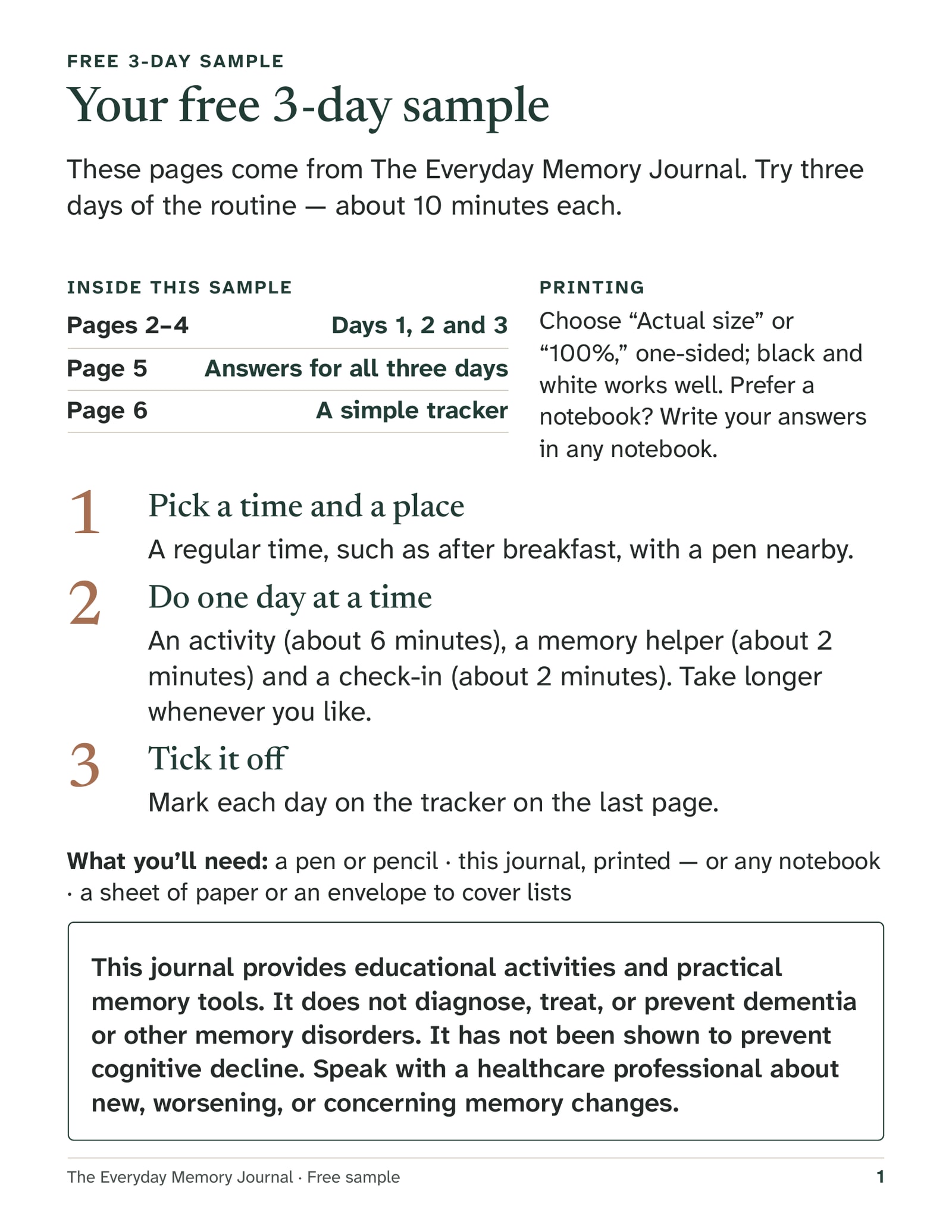
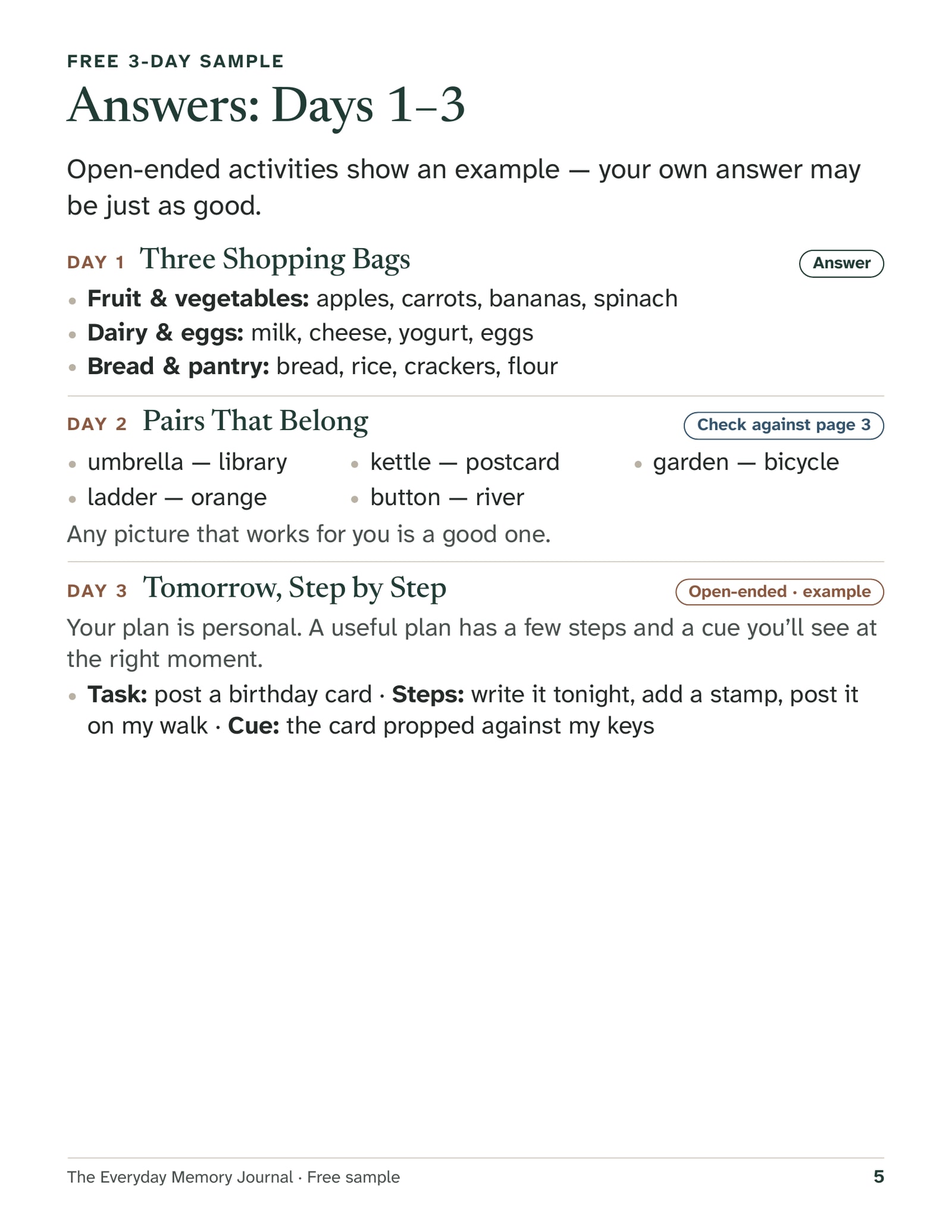
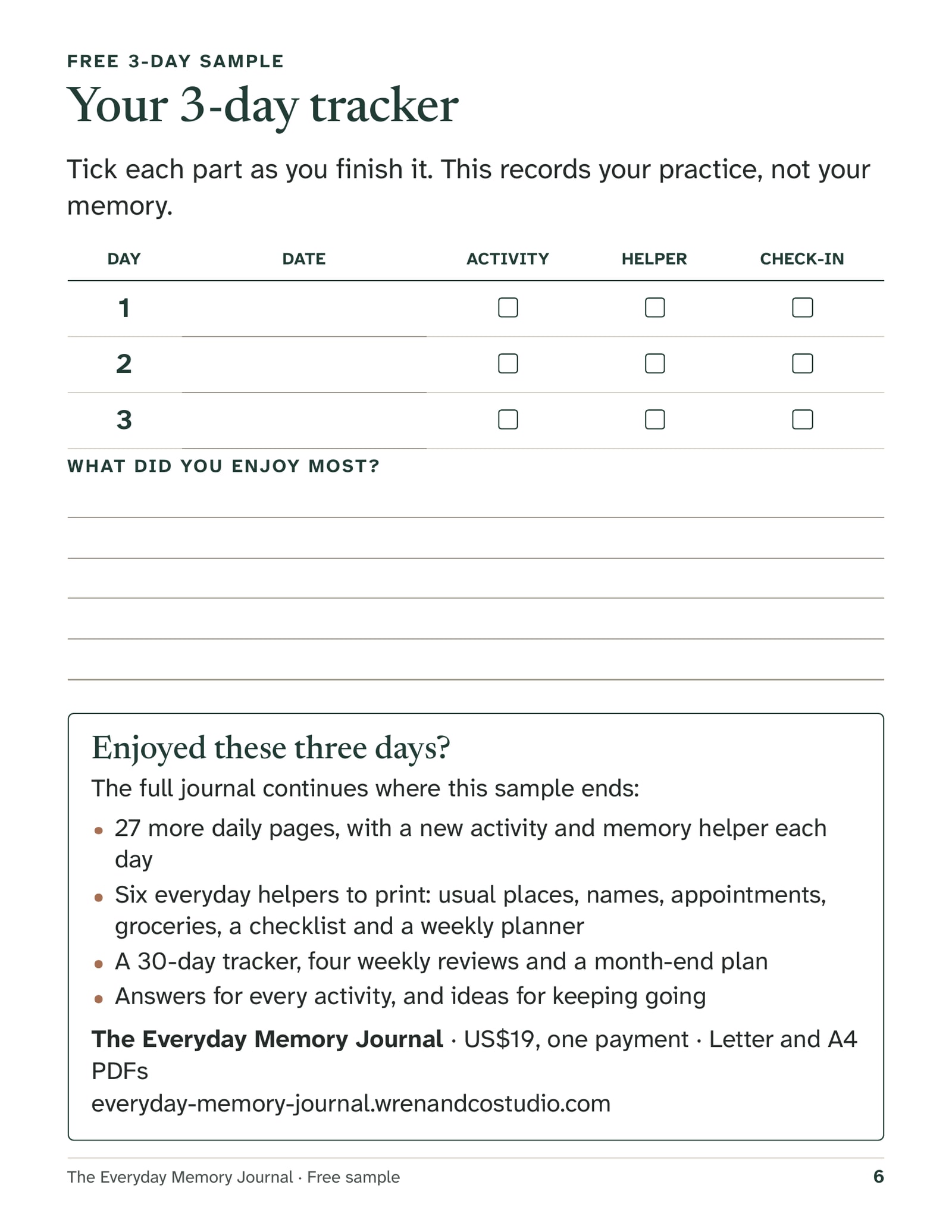
Six pages, taken straight from the journal: a quick-start page, Days 1 to 3, their answers and a small tracker. Select a page to see it full size.
What do the three days practice?
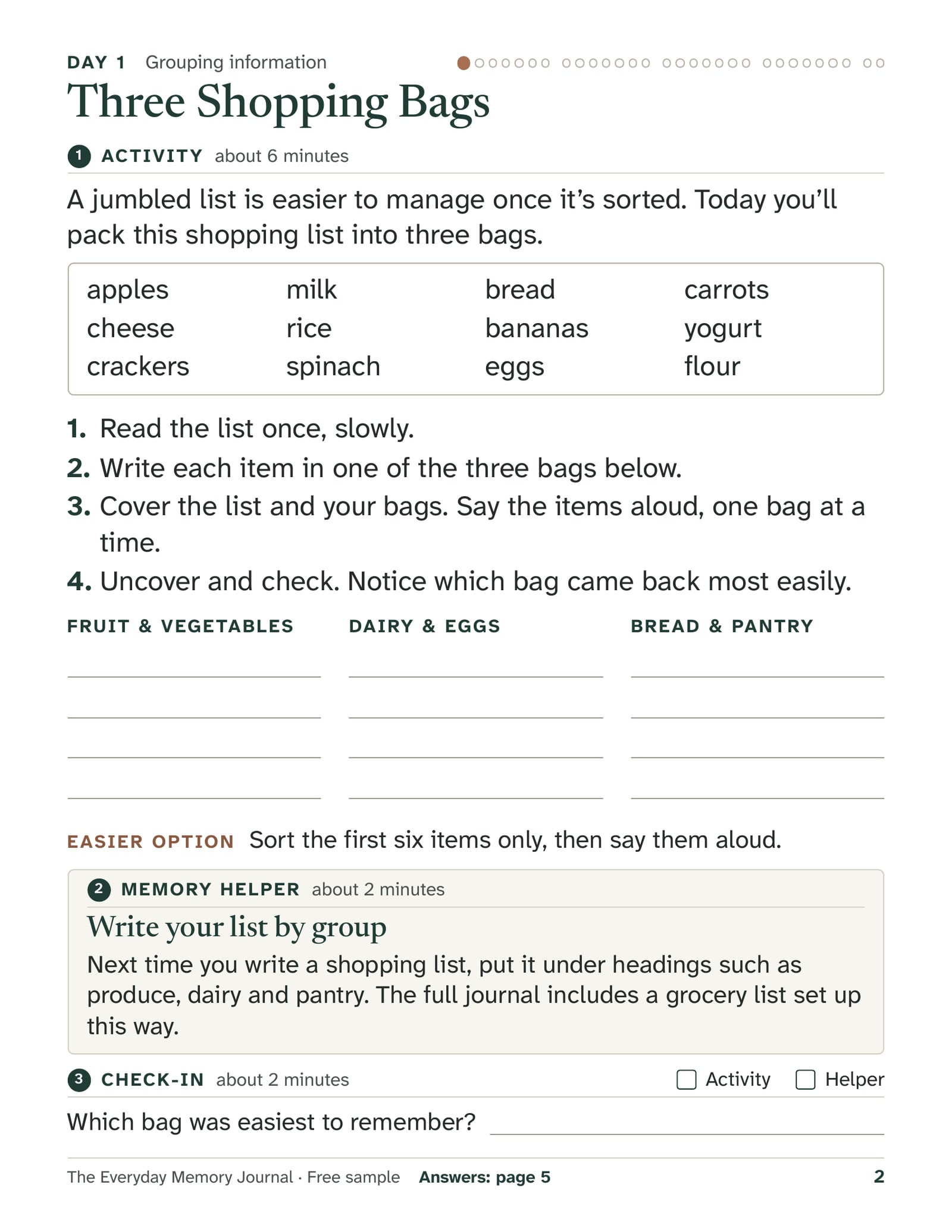
Day 1: Three Shopping Bags
A jumbled list is easier to manage once it’s sorted. Today you’ll pack this shopping list into three bags.
Memory helper: Write your list by group. Next time you write a shopping list, put it under headings such as produce, dairy and pantry. The full journal includes a grocery list set up this way.
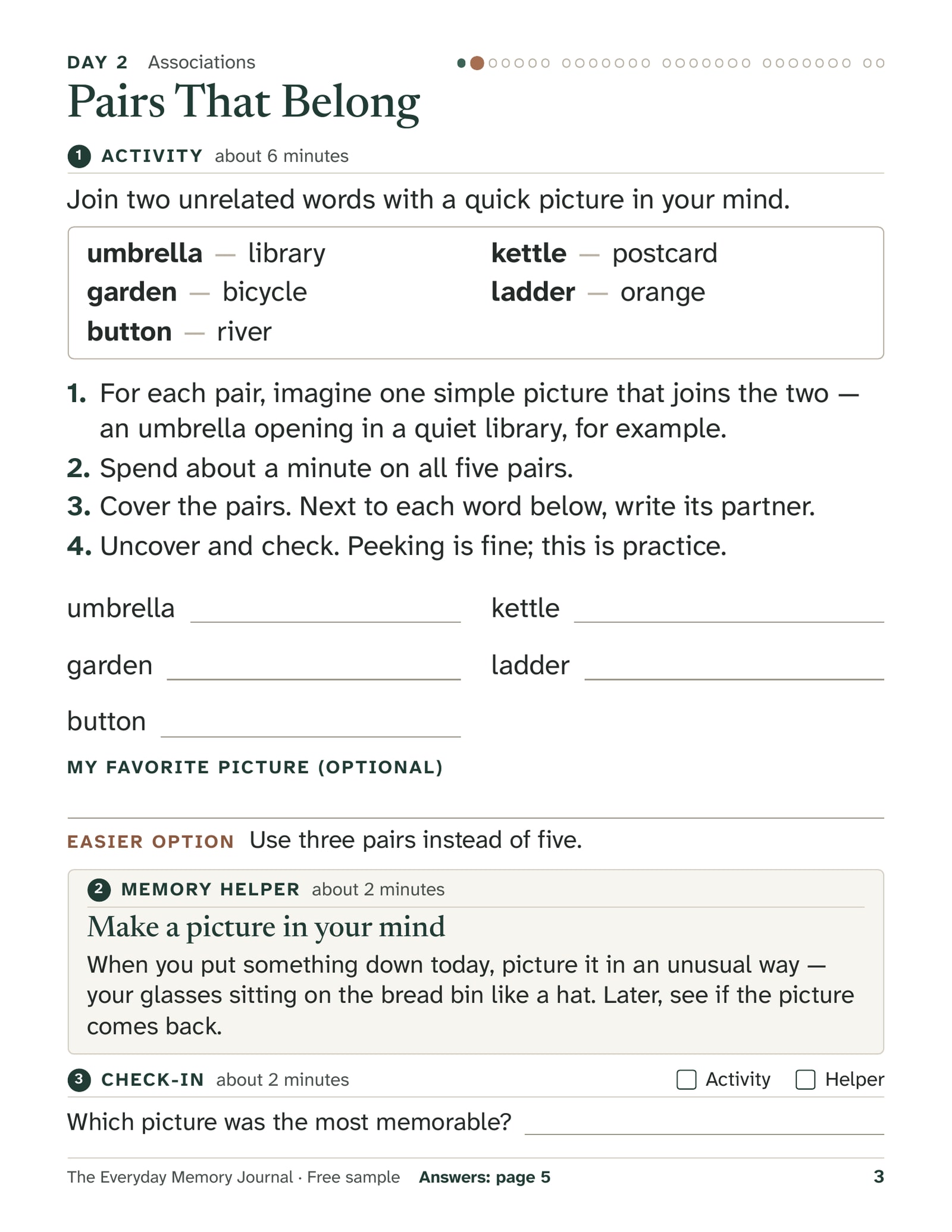
Day 2: Pairs That Belong
Join two unrelated words with a quick picture in your mind.
Memory helper: Make a picture in your mind. When you put something down today, picture it in an unusual way — your glasses sitting on the bread bin like a hat. Later, see if the picture comes back.
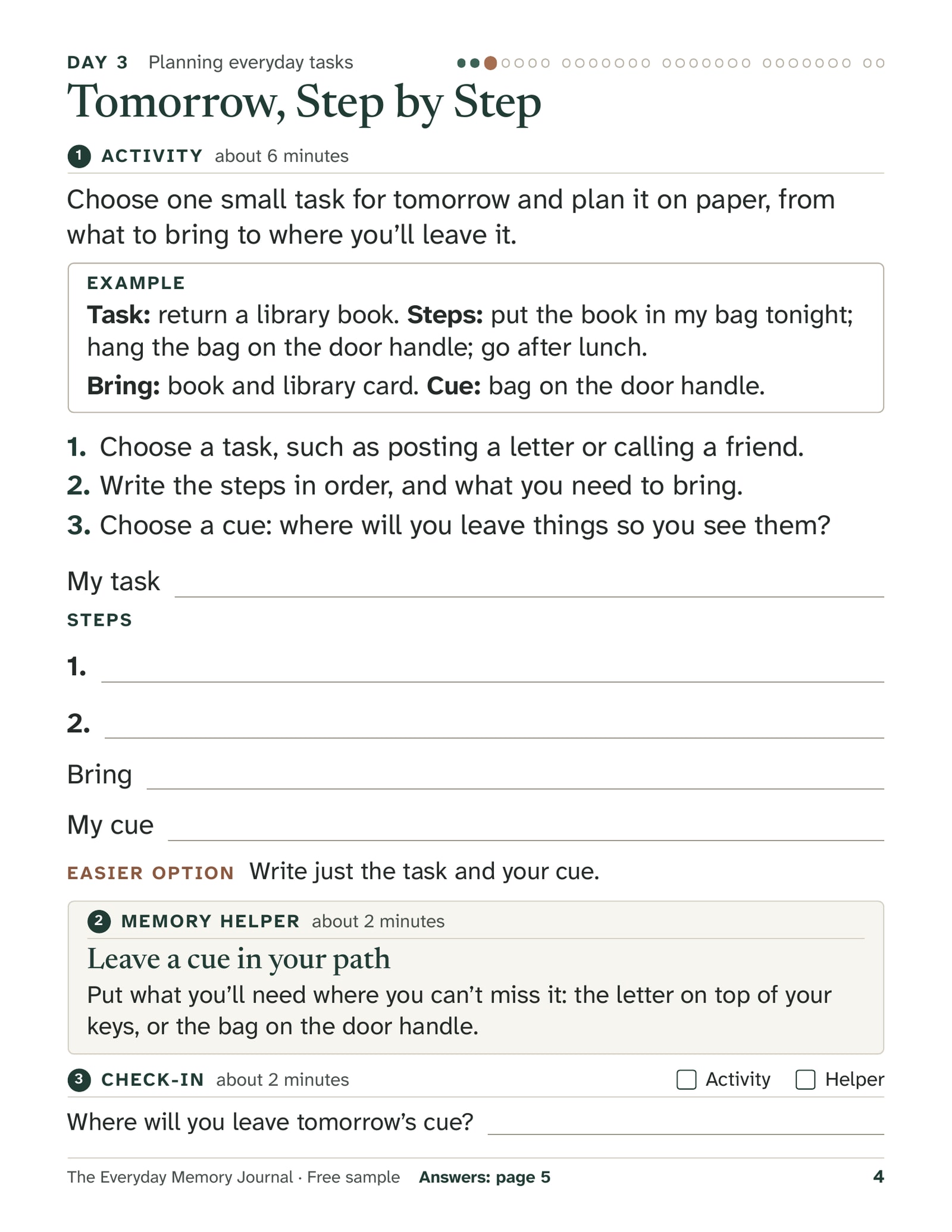
Day 3: Tomorrow, Step by Step
Choose one small task for tomorrow and plan it on paper, from what to bring to where you’ll leave it.
Memory helper: Leave a cue in your path. Put what you’ll need where you can’t miss it: the letter on top of your keys, or the bag on the door handle.
How do you use it?
- Pick a time and a place. A regular time, such as after breakfast, with a pen nearby.
- Do one day at a time. An activity (about 6 minutes), a memory helper (about 2 minutes) and a check-in (about 2 minutes). Take longer whenever you like.
- Tick it off. Mark each day on the tracker on the last page.
Choose “Actual size” or “100%,” one-sided; black and white works well. Prefer a notebook? Write your answers in any notebook.
Do memory activities actually work?
They are good practice and can be enjoyable, but no one can promise that they prevent memory loss.
The National Institute on Aging (NIA) says nothing has yet been proven to prevent Alzheimer’s disease, and it describes the evidence for brain training as encouraging but not conclusive.[1] Alzheimers.gov says no approach has been proven to prevent dementia.[2] The NIA also advises caution about products that promise to protect memory.[3]
What the NIA does suggest is easy to start: add one or two activities you enjoy to your routine.[4] That is what these pages are for.
Are they large print, and can I print them on A4?
Yes. The main text is 18 point, and both US Letter and A4 versions are free to download, with the same pages.
Print at “Actual size” or “100%,” one-sided. Black and white works well. You can also read the pages on screen and write your answers in a notebook.
Are these suitable for someone with dementia?
They weren’t designed or tested for people living with dementia.
They’re written for adults who want a short, friendly daily practice. If you’re looking for activities for someone living with dementia, their doctor or care team can suggest ones that fit.

Free by email
Five Memory Warm-Ups, free by email
Five short memory activities in the journal’s format, each about ten minutes, with answers. Ten large-print pages to print at home, in US Letter or A4. They aren’t in the free sample or the guides.
Get it freeIt’s free, and no card is needed. On Gumroad, the online shop we use, leave the price at 0, click “Add to cart” and enter your email address; the PDFs arrive straight away. You’ll then get occasional emails from Wren & Co.: up to five over three weeks (four with tips, the last about our US$19 journal), then only now and then. You can unsubscribe at any time. How we use your email
Questions about the sample
Is the sample really free?
Yes. Download it straight from this page. There is no sign-up and no email address to give.
Can I print it more than once, or share it?
Yes. Print as many copies as you like, and share it with friends or a group you lead, as long as it stays free.
Is this a memory test?
No. There are no scores or timers. Peeking is fine, and every day has an easier option.
Do I need to sign up?
No. The sample downloads straight from this page, with no account and no email address. A separate free pack, Five Memory Warm-Ups, comes by email if you’d like it.
What is in the full journal?
The Everyday Memory Journal continues where the sample ends:
- 27 more daily pages, with a new activity and memory helper each day
- Six everyday helpers to print: usual places, names, appointments, groceries, a checklist and a weekly planner
- A 30-day tracker, four weekly reviews and a month-end plan
- Answers for every activity, and ideas for keeping going
It costs US$19, one payment. See what’s included.
Sources
[1] Preventing Alzheimer’s Disease: What Do We Know?
nia.nih.gov/health/alzheimers-and-dementia/preventing-alzheimers-disease-what-do-we-know
[2] Can I Prevent Dementia?
[3] Memory Problems, Forgetfulness, and Aging
nia.nih.gov/health/memory-loss-and-forgetfulness/memory-problems-forgetfulness-and-aging
[4] Participating in Activities You Enjoy As You Age
nia.nih.gov/health/healthy-aging/participating-activities-you-enjoy-you-age